
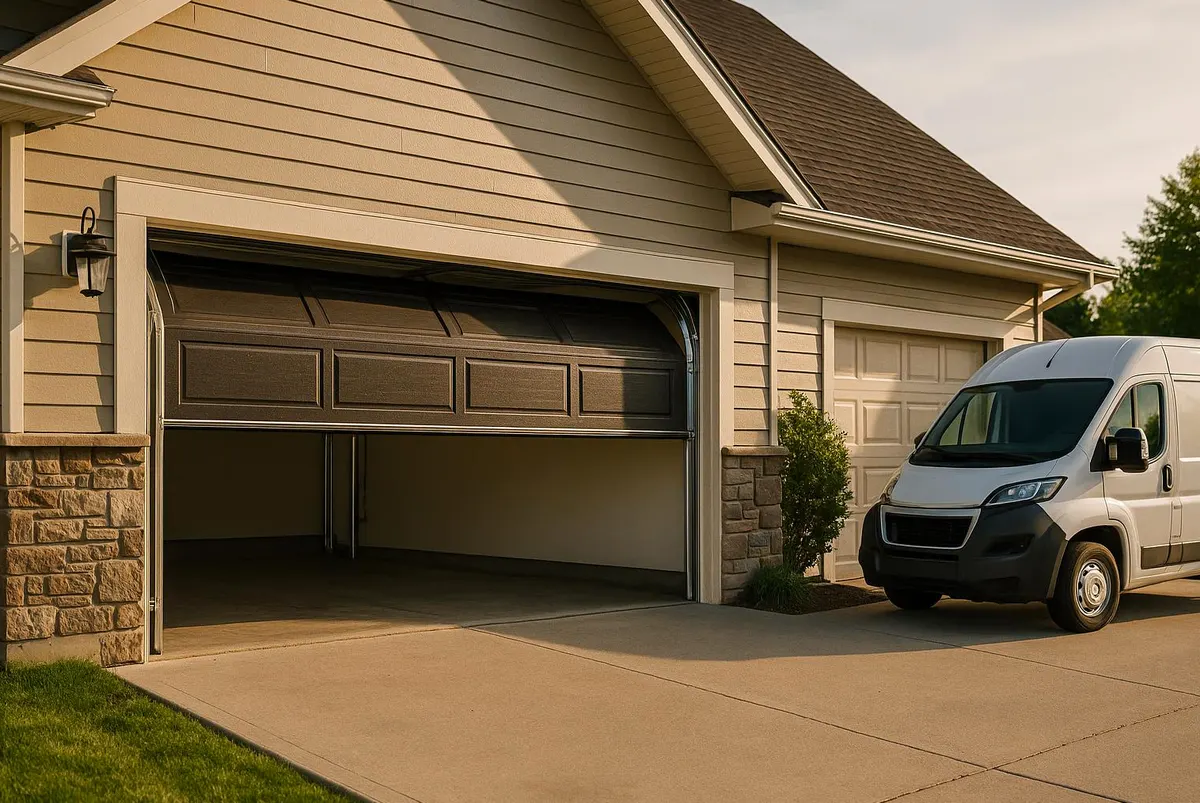
What a Technician Sees on a Typical Service Call
Most calls about tracks start the same way: the homeowner says the door is "making a weird noise" or "doesn't close right." When a technician gets eyes on it, the first thing they usually spot is a track that's no longer plumb against the frame, or one side riding slightly ahead of the other so the door climbs the track instead of sliding smoothly. In older homes around Citrus County, you'll often see rust bloom at the bracket joints, bolts backed halfway out of swollen wood framing, or a track that's been visibly knocked inward near the bottom few feet, right about bumper height on a car or golf cart.
Symptoms Homeowners Report
Before the cause is ever found, these are the signs that usually bring someone to pick up the phone:
- The door scrapes, grinds, or squeals in one spot every time it opens or closes
- Rollers pop partway out of the track and the door jerks
- One side of the door looks higher or lower than the other when it's halfway open
- Visible daylight or a gap between the roller and the track wall
- The door reverses on its own mid-cycle because the opener senses resistance
- A section of track looks bowed, dented, or pulled away from the wall
Any one of these on its own might be minor. Several together usually mean the track has shifted enough to affect how the whole door travels, and that's worth addressing before it turns into a bigger repair.
Causes, Checked in the Order a Technician Would Look
1. Impact Damage
This is the first thing a tech rules out, because it's the most common and the easiest to spot. A car bumper, a ladder, a trash can on a windy pickup morning, or a basketball hoop pole can all tap or crush the vertical track low to the ground. A light bend might just need to be pried back into shape and re-checked for square. A sharp crease or crushed rail almost always needs to be cut out and replaced, since bent metal rarely returns to true strength even after straightening.
2. Loose or Corroded Fasteners
Tracks are only as straight as the bolts holding them to the jamb. In this climate, afternoon humidity and salt-tinged air closer to the water work on steel brackets and lag bolts over time, and wood jambs can swell and shrink with moisture swings. A tech will check every bracket for play, strip out any rusted hardware, and re-set it with corrosion-resistant fasteners. If the wood behind the bracket has gone soft, that section gets reinforced or sistered before the track goes back up, otherwise the fix won't hold.
3. Frame or Slab Movement
Garage openings in older homes can settle slightly over the years, just enough to throw the left and right tracks out of parallel with each other even though neither one looks obviously damaged. A technician checks this with a level and a tape measure, comparing the opening's width top to bottom and the plumb of each track. If the frame has shifted, the fix is usually shimming the brackets rather than trying to force the track itself back into line.
4. Storm and Wind-Load Stress
Hurricane season puts real force on a garage door, and even a storm that doesn't cause obvious damage can rack the door enough to flex the tracks, especially on older doors that predate current wind-load bracing standards. After any significant wind event, it's worth having the tracks, rollers, and reinforcing struts checked, since a door that looks fine closed can still be out of alignment when it cycles.
5. Worn Rollers and Track Wear
Sometimes the track itself isn't bent at all, it's the rollers. Old steel or dried-out nylon rollers wear unevenly and ride rough inside the channel, which can look and sound exactly like a misaligned track. A tech checks roller condition last because it's the cheapest, simplest fix, swapping worn rollers for new ones often resolves noise and binding without touching the track at all.
When to Call Crystal River Garage Door Service
If your door is scraping, jumping off the roller, or visibly crooked when it's halfway open, that's past the point of a DIY fix. Forcing a misaligned door with the opener can bend the track further, strip gears, or pull brackets clean out of the frame. Our Off Track Door Repair service covers exactly this: realigning or replacing bent sections, re-securing brackets into solid framing, and making sure both tracks run parallel before we test the door through a full cycle. If it's been a while since anyone's looked at your rollers, hinges, or hardware, pairing that with our Garage Door Tune-Up & Maintenance service catches rust and wear before it turns into another track problem down the road.
If your garage door in Crystal River, Homosassa, Inverness, Lecanto, Beverly Hills, Citrus Springs, Hernando, or Dunnellon is scraping, sticking, or running crooked, call Crystal River Garage Door Service and we'll get it back on track, literally.